The routes that move 80% of global trade
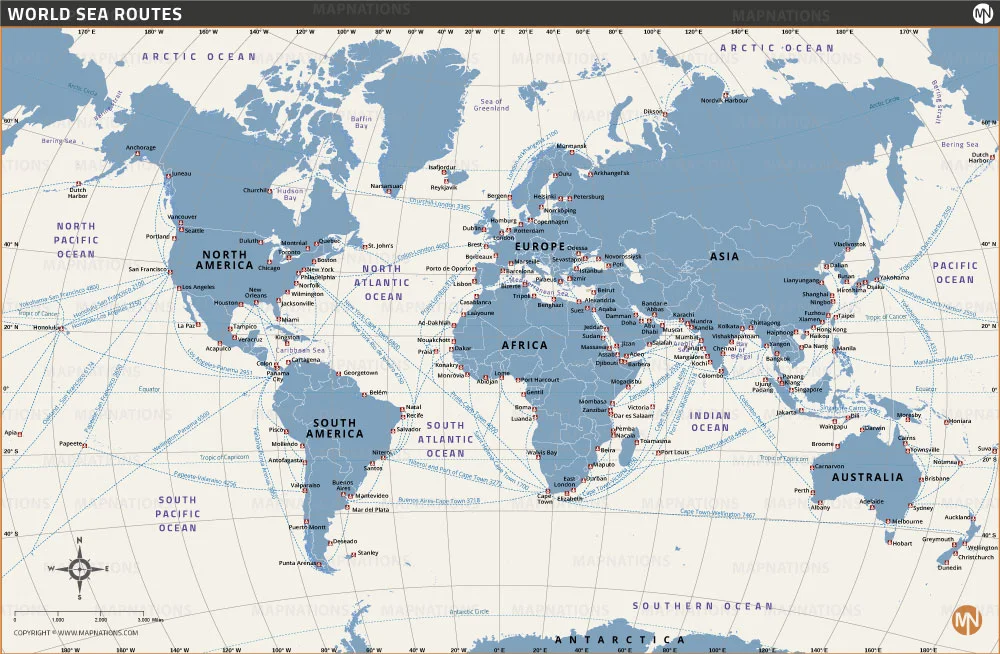

In the transport of goods, there are maritime routes that are key to global trade. These routes carry an enormous flow of ships that use them to save costs and time in navigation. Throughout history, many of these waterways have made it possible to consolidate entire supply chains covering much of the planet, turning them into strategic points.
Today, maritime transport is the main means of international trade, moving more than 80% of the world's goods. Thanks to these routes, it is possible to connect continents, supply markets, and sustain the global economy.
Although they often go unnoticed, these routes are essential to everyday life: from the fuel we use to the products we consume daily, much depends on keeping these passages open, safe, and efficient to guarantee the constant flow of goods worldwide. These are the six main maritime trade routes in the world.
Panama Canal
The Panama Canal was built to connect the Pacific Ocean with the Caribbean and the Atlantic. It is key to trade between Asia, North America, and South America. Since its inauguration in 1914, it has saved transit time for countless ships and allowed them to avoid the Strait of Magellan or the Drake Passage, which are quite dangerous routes.
By not having to sail around the entire South American continent, ships can significantly reduce their travel time. This shortens the distance between the east and west coasts of the Americas. Approximately 5% of world maritime trade passes through this canal, and about 70% of the cargo that crosses it originates from or is destined for the United States, making it a key strategic point for its trade.
Suez Canal
The Suez Canal was created to connect the Red Sea with the Mediterranean Sea. It is key to trade between Europe, the Middle East, and Africa, as it saves a great deal of time and cost in maritime transport. Before it existed, ships had to sail around much of the African continent by way of the Cape of Good Hope.
It accounts for roughly 10% to 12% of world maritime trade. However, threats in the Red Sea, such as attacks by armed groups in Yemen, have driven up maritime insurance and forced ships to reroute around Africa, increasing costs and transit times. In addition, the presence of U.S. and Chinese military bases in Djibouti, near the Bab el-Mandeb strait, shows the great strategic importance of this region for global trade.
Strait of Hormuz
The Strait of Hormuz is key to the movement of oil and gas worldwide. It connects the Persian Gulf with the Indian Ocean and allows countries such as Qatar, Saudi Arabia, the United Arab Emirates, Kuwait, and Iran to export their energy resources by sea.
It is estimated that around 20% of the world's oil passes through this strait, making it a fundamental strategic point. Due to tensions in the region, any threat of closure has a direct impact on the price of oil and on maritime transport costs. This can trigger increases in freight rates worldwide and delays in supply chains because of the risk in the area.
Strait of Malacca
The Strait of Malacca is a strategic point in the Indo-Pacific, as an immense flow of goods between Southeast Asia and China passes through it in both directions. Located between Singapore, Malaysia, and Indonesia, it allows passage between the Indian Ocean and the Pacific Ocean.
It saves time and money in maritime transport, and approximately 25% of world trade passes through this strait. Given that countries like China have become essential to global supply chains, this route is key to international trade. In addition, major economies such as Japan, South Korea, and Singapore depend on this passage, which explains the strategic presence of powers like the United States in the region to ensure maritime security.
Strait of Gibraltar
The Strait of Gibraltar is a key point connecting the Mediterranean Sea with the Atlantic Ocean. Located between Spain and Morocco, it serves as the main entrance to and exit from the Mediterranean.
It is essential to trade between Europe and Africa, and much of the goods leaving the Mediterranean bound for the Americas pass through this strait. It is estimated that around 10% of world maritime trade transits this area, establishing it as a logistics hub of great importance.
English Channel (Strait of Dover)
The English Channel, especially the Strait of Dover, is one of the busiest maritime routes in the world. Each day, between 500 and 600 ships cross this strait separating the United Kingdom and France, reflecting its enormous importance for international trade.
Cargo such as oil from the Middle East bound for Europe travels through this route, as well as goods coming from North and South America. It is also essential for European ports such as the Port of Rotterdam, as it constitutes the main access route from the Atlantic Ocean to the North Sea, connecting Europe with global trade.
The world's main maritime routes are essential to the functioning of global trade, as they reduce transport costs and times, facilitating the exchange of goods between continents. These strategic passages connect the world's leading economies and make possible the constant supply of products, energy, and raw materials.
However, they also represent critical points within the international trade system. Any disruption, whether from geopolitical conflicts, attacks, accidents, or logistical problems, can have significant impacts on supply chains, raising costs, delaying deliveries, and affecting the global economy.
For this reason, the security, stability, and control of these maritime routes are fundamental, not only for the countries directly involved, but for the functioning of international trade as a whole. In an increasingly interconnected world, these maritime corridors will remain key to economic development and global integration.

