Written by: Jack Acrich

In recent years, nearshoring has gone from being a strategic alternative to becoming a central element of global supply chains. This model, which consists of relocating production processes or services to countries close to the final market, has gained importance across the Americas, driven by structural changes in international trade and by the need to reduce operational risks.
For decades, many companies opted for offshoring, locating their production in distant regions such as China or India, attracted mainly by lower labor costs. However, recent events such as the COVID-19 pandemic exposed the vulnerabilities of this model, with logistical disruptions, extended delivery times, and a lack of visibility across supply chains. In addition, trade tensions between the United States and China have prompted many companies to reconsider their dependence on Asia.
In this context, nearshoring has emerged as a solution that reduces risk without sacrificing efficiency. Geographic proximity promotes shorter transit times, greater control over production, and smoother communication thanks to aligned time zones. Accordingly, it is estimated that many multinational companies are planning to increase their use of nearshoring strategies in the coming years.
The impact of this trend is already visible in Latin America and the Caribbean. According to the Inter-American Development Bank, nearshoring could generate up to 78 billion dollars in additional annual exports for the region in the short and medium term. Countries such as Mexico have been the main beneficiaries so far, owing to their proximity to the United States and their integration into regional trade agreements. Nonetheless, other countries are beginning to position themselves as complementary destinations in this new global trade landscape.
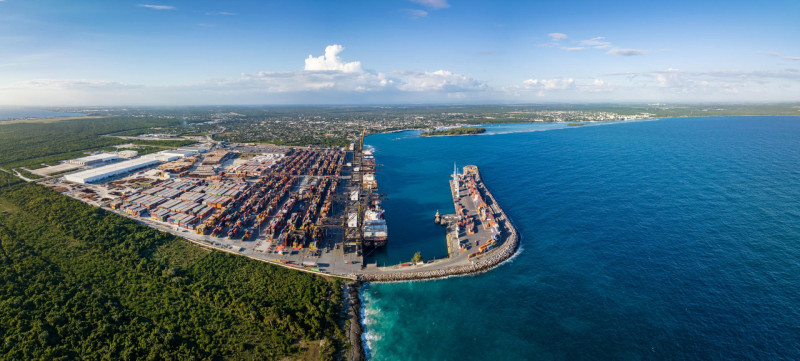
Among them, the Dominican Republic has been gaining greater visibility as a strategic point within the Caribbean. Its geographic location, close to the east coast of the United States, allows for considerably shorter transit times compared with Asia, which represents an important advantage for companies seeking greater agility in their operations. In addition, the country has a developing logistics infrastructure, with the presence of DP World Caucedo, which serves as a relevant hub for regional manufacturing and distribution.
Another relevant factor is the free-trade-zone regime in the Caribbean nation, which has been key to attracting foreign investment for decades. This model offers tax incentives, legal stability, and favorable conditions for export, which has enabled companies to establish themselves in sectors such as textiles, medical devices, and light manufacturing. The expansion of operations by companies such as Hanesbrands, together with the presence of global health-sector firms such as Medtronic and Johnson & Johnson, demonstrates the interest in investing in and developing industries in the Dominican Republic.
An additional element that has reinforced this trend in recent years is U.S. trade policy. In this regard, the Donald Trump administration implemented high tariffs on products from China, in some cases exceeding 100% depending on the sector, as part of a strategy to reduce dependence on Asian manufacturing and encourage production relocation. Although countries like the Dominican Republic have been subject to considerably lower tariffs, in many cases staying around 10%, this relative difference in the cost of accessing the U.S. market has helped make production in nearby economies more attractive.
It is also worth noting that the availability of competitive labor and the growing specialization in services and advanced manufacturing broaden the country's potential beyond traditional production. In this sense, nearshoring does not only involve relocating factories, but also redistributing productive and service capabilities within regions closer to the final market.
Within this transformation, freight forwarders are also beginning to play an increasingly strategic role. Beyond coordinating international transport, these companies can become key logistics partners for businesses looking to establish nearshoring operations in the region. In the case of the Dominican Republic, freight forwarders have the opportunity to offer comprehensive solutions that include warehousing, cargo consolidation, customs handling, regional distribution, and effective coordination across sea, air, and land transport. Likewise, proximity to the United States makes it possible to develop more agile and flexible logistics schemes, something especially important for industries that depend on dynamic inventories and fast response times.
Despite the opportunities that nearshoring offers, it is important to keep in mind that the implementation process presents certain challenges. These include the initial costs of relocation, the need to improve infrastructure, regulatory complexity, and competition among countries in the region to attract investment. For this reason, many companies are adopting hybrid approaches that combine different geographies, seeking to balance efficiency, cost, and resilience in their operations. As a result, nearshoring is likely to develop gradually over the coming years, as companies try to diversify their risk and relocate their supply chains in the most convenient way possible.
This combination of measures, legal adjustments, geopolitical tensions, and possible future changes has created a level of uncertainty that has reinforced the appeal of nearshoring. Instead of relying on long chains exposed to geopolitical or regulatory shifts, many companies are choosing to diversify their production toward closer, more stable regions within the Americas. Nearshoring represents a significant evolution in how companies organize their supply chains. More than a passing trend, it is an adaptation to a more uncertain global environment, where proximity, flexibility, and responsiveness have become decisive factors. Within this new landscape, Latin America and the Caribbean, and the Dominican Republic in particular, have the opportunity to play an increasingly relevant role in international trade. In this process, Dominican freight forwarders and logistics operators could become essential players in facilitating regional integration, strengthening supply chains, and positioning the country as a strategic logistics hub within the Americas.
Sources
https://www.ttec.com/glossary/what-is-nearshoring-definition-and-benefits
https://www.bain.com/insights/nearshoring-overcoming-the-obstacles/
https://www.santander.com/en/press-room/features/the-power-of-nearshoring-in-the-americas
https://tractian.com/es/blog/que-es-el-nearshoring-ventajas-ejemplos-y-como-prepararse

